
Parsippany Elite Roofing has handled roof repair across Parsippany, NJ for more than 20 years, serving surrounding cities including Hanover, East Hanover, Denville, Florham Park and West Caldwell. Our repair visits start with a simple rule: before anything is priced, we find where the water actually gets in. That means looking at the roof from the outside and from the attic, because the stain on a bedroom ceiling is rarely sitting under the real opening.
A lot of roofs in Morris County are older capes, split-levels and colonials with several decades of patching behind them. Many of them still have plenty of life left, and a focused repair is the right call. Others have reached the point where another patch simply delays the inevitable, and we say that plainly before replacement is ever brought up.
Every repair we quote is written as a short, itemized scope. You see what will be removed, what will be replaced, and what flashing, boots or decking are involved. That makes it easy to compare our price with anyone else’s and to understand exactly what you are paying for.
Finding the Source Before Fixing the Roof
Tracing Roof Leaks From the Attic Side
Water that gets past a shingle travels along the sheathing, down rafters and across the top of insulation before it shows up on a ceiling. Our crew checks the attic for stained wood, damp insulation, rusty nail tips and pinholes of daylight. Those clues tell us which part of the roof is failing and whether the problem is a single spot or a wider pattern.
This step is also where hidden damage shows itself. Soft decking, mold on the underside of the sheathing, or frost on nail tips in winter all point to conditions a patch on top would never solve. Finding them early keeps a modest repair from turning into a larger one next season.
Inspecting Flashing, Boots and Penetrations
Most leaks on a shingle roof start at a joint rather than in the middle of a slope. Step flashing along walls, counter flashing set into a reglet, chimney flashing, and the rubber pipe boots around plumbing vents all age faster than the shingles around them. A cracked pipe boot can let water in for months before anyone notices a stain.
We check each penetration and wall line by hand and photograph what we find. When a boot is split or a flashing piece is rusted through, we replace it with new material rather than sealing over the old part. Caulk on its own is a temporary measure, and we label it that way when it is the only option for a short time.
Reading the Shingles for Age and Wear
Granule loss, curled tabs, cracked edges and shingles that lift in the wind tell us how much life the roof has left. A few damaged shingles on an otherwise sound roof are a normal repair. Widespread granule loss in the gutters and brittle tabs that crack when lifted point toward a roof near the end of its service.
We share photos of what we see and give you a straight answer on whether repairing makes sense. If the shingles still bend without cracking and the decking is sound, a repair is usually the most sensible choice. If they do not, we explain why and leave the decision with you.
Residential Roof Repair Work
Shingle Replacement and Wind Damage Repair
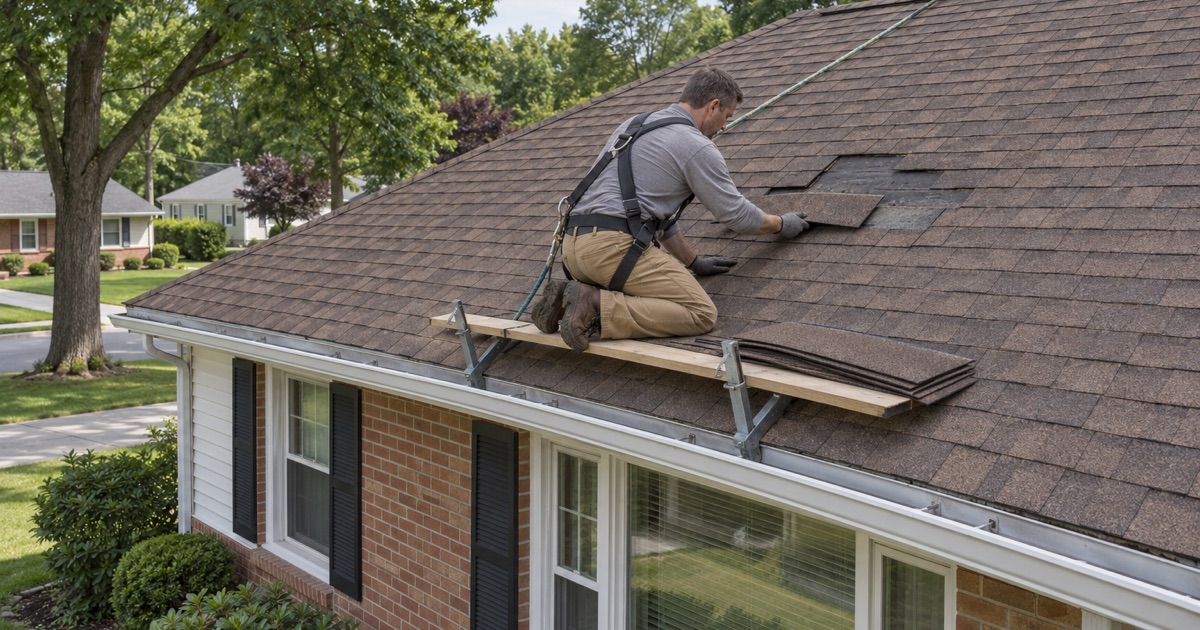
Wind lifts shingles along rakes, ridges and the upper edges of a slope, breaking the seal strip and sometimes tearing tabs away completely. We remove the damaged shingles, check the underlayment beneath them, and weave in new architectural shingles matched as closely as possible to the existing roof. Each new piece is nailed in the correct zone so it seals properly as the weather warms.
Where several shingles have lifted along one edge, we also look at whether the drip edge or starter course is missing or failing. A roof that keeps losing shingles in the same place usually has an installation problem rather than bad luck. Fixing that underlying detail is what stops the repeat calls.
Flashing, Valley and Wall Line Repairs
Valleys collect the most water on any roof, and on wooded lots they also collect leaves and needles that hold moisture against the shingles. We clear valleys, replace worn shingles or metal, and rebuild open or closed valleys when the old work has failed. Wall lines and dormer cheeks get new step flashing and counter flashing where the old pieces have rusted or pulled away.
Kick-out flashing at the bottom of a roof-to-wall joint is a small part that prevents a large problem. Without it, water runs behind siding and into the wall framing. We add kick-out flashing whenever it is missing during a repair, because it is far cheaper than repairing rotted sheathing later.
Chimney, Skylight and Vent Leaks
Chimneys and skylights are two of the most common leak sources we see. Around a chimney, we check the step and counter flashing, the crown and the mortar joints, and whether a cricket is needed on the uphill side to split the water. Around a skylight, we look at the flashing kit, the seals and the glazing, since each can fail on its own.
Roof vents, exhaust caps and pipe boots round out the list. We replace cracked boots with new rubber or lead boots and reseal vent flanges under the shingle courses rather than on top of them. A properly lapped detail sheds water by gravity instead of depending on sealant alone.
Ice Dam Damage Along the Eaves
Older capes and split-levels across the area are prone to ice dams when warm attic air melts snow higher on the roof and it refreezes at the cold eave. The meltwater backs up under the shingles and into soffits, walls and ceilings. We repair the damaged eave, install a self-adhering ice and water barrier that meets ASTM D1970 where the shingles are opened, and check the attic ventilation that caused the melt.
The repair alone treats the symptom, so we also look at insulation gaps, blocked soffit vents and missing ridge ventilation. When the attic stays closer to outdoor temperature, the snow melts more evenly and the dam is far less likely to form again. That combination is what keeps the stain from coming back next winter.
Flat and Low-Slope Roof Repair
Porch Roofs, Additions and Garage Roofs
Many homes here have a flat or low-slope section over a porch, a rear addition or an attached garage. These areas are often covered with rolled roofing, torch-down modified bitumen or an EPDM rubber membrane. We find the failed seam, blister or puncture and repair it with compatible material so the patch bonds properly.
Where a low-slope section meets a shingled wall, the transition flashing is a frequent weak spot. We rebuild that joint so water from the steeper roof cannot run behind the membrane. If the entire flat section is near the end of its life, we tell you so and price both a repair and a recovering.
Small Commercial and Mixed-Use Roofs
We also repair roofs on small office buildings, storefronts and mixed-use properties, where membrane roofs such as TPO, PVC and EPDM are common. Typical problems are open seams, failed perimeter flashing, punctures around rooftop equipment and clogged drains or scuppers that let water pond. Each repair is documented with photos for the owner or property manager.
Commercial repairs are scheduled around business hours where possible, and the crew follows fall protection rules on every roof. Building owners get a written summary of what was repaired and what to watch for. That record helps when budgeting for future roof work.
When a Repair Is Not the Right Answer
Signs the Roof Has Reached the End of Its Life
Repeated leaks in different spots, shingles that crack when lifted, heavy granule loss and soft decking across several areas are all signs that repairs will keep chasing new problems. Two or more existing layers also limit repair options, since New Jersey’s rehabilitation subcode requires a tear-off before another layer goes on. We explain these findings in writing so you can plan ahead.
We would rather tell you a roof can be repaired than sell you one you do not need yet. When replacement truly is the better value, the estimate shows why, with the same itemized scope we use for repairs. You decide on your own timeline.
Temporary Repairs After Storm Damage
After a wind storm or a falling limb, the first job is keeping water out of the house. We set tarps and make temporary repairs the same day when possible, and we take photos before anything is moved. Those photos and our written notes give you a clear record for your own insurance claim.
Once the house is protected, we return to make the permanent repair. If the damage is extensive, we will meet your adjuster on site when asked and walk through what we found. The claim stays yours, and our role is to give you accurate evidence.
Keeping the Work Area Clean
Every repair visit ends with cleanup, including the gutters, the yard and the driveway. We run a magnetic sweeper across the lawn and walkways to pick up loose roofing nails. Old shingles, boots and flashing are hauled away the same day.
We also clear any debris that fell into the gutters during the repair. A clean gutter run lets the new work drain the way it should during the next storm. It is a small step, and it is one homeowners notice.
- 20+ Years on Local Roofs
- Itemized Written Scopes
- Same-Day Storm Tarping