
Parsippany Elite Roofing has provided roof leak repair in Parsippany, NJ for more than 20 years, serving surrounding cities including Hanover, East Hanover, Denville, Florham Park and West Caldwell. Every leak call starts in two places: on the roof and in the attic. Water travels before it drips, so the stain on your ceiling is a clue to follow rather than the spot to patch.
That tracing step is what separates a lasting repair from a recurring one. A ceiling stain can sit several feet away from where water actually gets past the shingles, and patching above the stain often misses the real opening entirely. We follow the path back to the source and only then put a price on the fix.
Once the source is found, the repair is focused on it. You see photos of the opening, a short written scope of what will be replaced, and an honest view of whether the rest of the roof is sound. If the leak is a symptom of a roof at the end of its life, we say that clearly.
How We Track Down a Roof Leak
Starting From the Ceiling Stain
We begin inside the house, noting where the stain sits, how large it is and whether it grows during certain storms. A stain near an exterior wall often points to a different source than one in the middle of a room. Bathroom ceilings raise the question of condensation or a fan duct rather than a roof opening.
Your own observations matter here. Knowing whether the leak shows up in every rain, only in wind-driven storms, or only when snow melts narrows the search considerably. We ask those questions before we climb anything.
Following the Water Through the Attic
In the attic, water leaves a trail. Stained sheathing, dark streaks down rafters, damp or compressed insulation and rusty nail tips show the route water has taken. We trace that route uphill to the highest wet point, which is usually close to where the water entered.
We also look for daylight through gaps around chimneys, vents and skylight frames. A pinhole of light beside a pipe boot or along a wall line often confirms the source on the spot. When nothing is obvious, the pattern of stains still tells us which section of the roof to examine closely.
Confirming the Source on the Roof
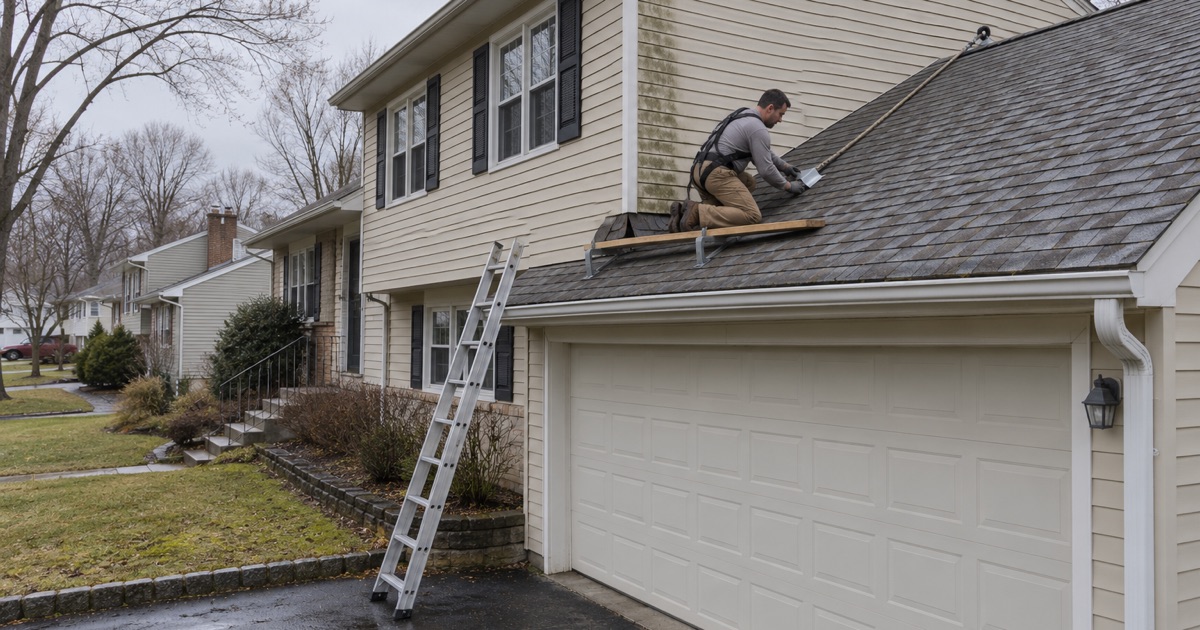
With the attic evidence in hand, we inspect the matching area of the roof by hand. Cracked pipe boots, lifted shingles, open seams in valleys, rusted step flashing and missing kick-out flashing are common findings. Each is photographed before anything is moved.
Intermittent leaks sometimes need a controlled water test. We wet one section of the roof at a time, starting low and working upward, while someone watches from the attic. The moment water appears inside, the source is confirmed and the repair can be targeted.
Common Roof Leak Sources and Their Repairs
Pipe Boots and Roof Vents
The rubber collar around a plumbing vent pipe is one of the most common leak points on any roof. Sun and cold crack the rubber over time, and water runs down the pipe into the attic. We replace cracked boots with new rubber or lead flashing boots, lapped under the shingles above and over the shingles below.
Exhaust vents, attic fans and box vents fail in similar ways, usually through cracked flanges or missing fasteners. We reset or replace the vent and seal it within the shingle courses. Surface caulk is not treated as a permanent fix.
Chimney Flashing and Masonry
Chimneys collect water on the uphill side and shed it around both sides, so their flashing works harder than almost anywhere else. Leaks usually come from loose counter flashing, rusted step flashing or a missing cricket. We rebuild the flashing, cutting counter flashing into a reglet in the mortar joint so it stays sealed.
Sometimes the water is coming through the chimney itself. A cracked crown, open mortar joints or a missing cap can let water soak into the masonry and appear in the attic beside the flue. We check those parts too, so the right repair is made.
Valleys and Roof-to-Wall Joints
Valleys carry the water from two slopes, and on wooded lots they also fill with leaves that hold moisture against the shingles. Worn valley shingles, exposed nails and failed metal let water through. We clear the valley, replace the damaged material and rebuild it with ice and water barrier underneath.
Where a roof meets a sidewall, step flashing should be woven into each course of shingles. Missing kick-out flashing at the bottom of that joint sends water behind siding and into the wall. We add or replace the flashing so water stays on the roof and in the gutter.
Skylight Leaks
Skylights leak at the flashing, at the seals around the glass, or through condensation on the inside of the frame. We check each of these to tell them apart. A flashing leak shows up after rain, while condensation appears on cold mornings even without rain.
Flashing leaks are repaired with a new flashing kit and underlayment around the curb. If the seals or glazing have failed on an older unit, we explain whether repair or replacement is more sensible. Our skylight installation service covers full replacements when needed.
Seasonal Leaks in Northern New Jersey
Ice Dams Along the Eaves
Older capes and split-levels across Morris County often see ice dams in winter. Heat escaping into the attic melts snow higher on the roof, and the water refreezes at the cold overhang, backing up under the shingles. Stains along the exterior walls and in the soffits are a typical sign.
We repair the damaged eave with self-adhering ice and water barrier meeting ASTM D1970, then look at what caused the melt. Blocked soffit vents, missing ridge ventilation and thin insulation over the top plates are common culprits. Correcting them is what keeps the leak from returning next winter.
Wind-Driven Rain and Storm Damage
Strong storms drive rain sideways under shingle edges and through rake details, and they lift shingles that have lost their seal. Falling limbs from mature trees can puncture the roof outright. After a storm, we set tarps and temporary repairs the same day when possible, with photos taken before anything is moved.
Those photos and our written notes support your own insurance claim. When you ask, we will meet the adjuster on site and walk through the damage. The permanent repair follows once the house is dry and the scope is agreed.
Condensation That Looks Like a Leak
Not every wet attic has a roof leak. In winter, warm, moist air from the house can condense on the cold underside of the sheathing and drip back down. Frost on nail tips, wet insulation spread evenly across the attic, and no matching opening on the roof all point to condensation.
The fix in that case is ventilation and air sealing, not roofing. We explain what we found and what would solve it. Repairing shingles for a condensation problem would cost money and change nothing.
Making the Repair Last
Repairing Damaged Decking
A leak that has run for months often softens the sheathing around the opening. We open the area, replace any rotted decking and photograph it before it is covered. Replacement sheets are priced in the written scope, so there are no surprises.
New underlayment and shingles are woven into the surrounding roof so the repair blends in and sheds water properly. We match the existing shingles as closely as possible. On older roofs, the new pieces may look slightly brighter until they weather.
Cleanup and Follow-Up
When the repair is finished, we clean the gutters, yard and driveway, including a magnetic sweep for nails. We also check the attic again after the next significant rain if you would like us to. A dry attic after a real storm is the best proof that the leak is solved.
- 20+ Years on Local Roofs
- Itemized Written Scopes
- Same-Day Storm Tarping