
Parsippany Elite Roofing provides commercial roofing in Parsippany, NJ and has worked on roofs throughout the area for more than 20 years, serving surrounding cities including Hanover, East Hanover, Denville, Florham Park and West Caldwell. Our commercial work covers offices, storefronts, mixed-use buildings, small warehouses and multifamily properties. Most of these buildings have low-slope roofs with membrane systems, which call for different materials and methods than a shingled house.
Commercial owners and property managers need something homeowners rarely ask for: a clear record. Every inspection, repair and replacement we do on a commercial building comes with photos and a written summary. That record helps with budgeting, tenant questions and insurance claims later.
Our proposals list each part of the work separately, from tear-off and insulation to membrane, flashing, drains and edge metal. That makes it possible to compare bids line by line rather than guessing what one number includes.
Commercial Roofing Systems
TPO and PVC Single-Ply Membranes
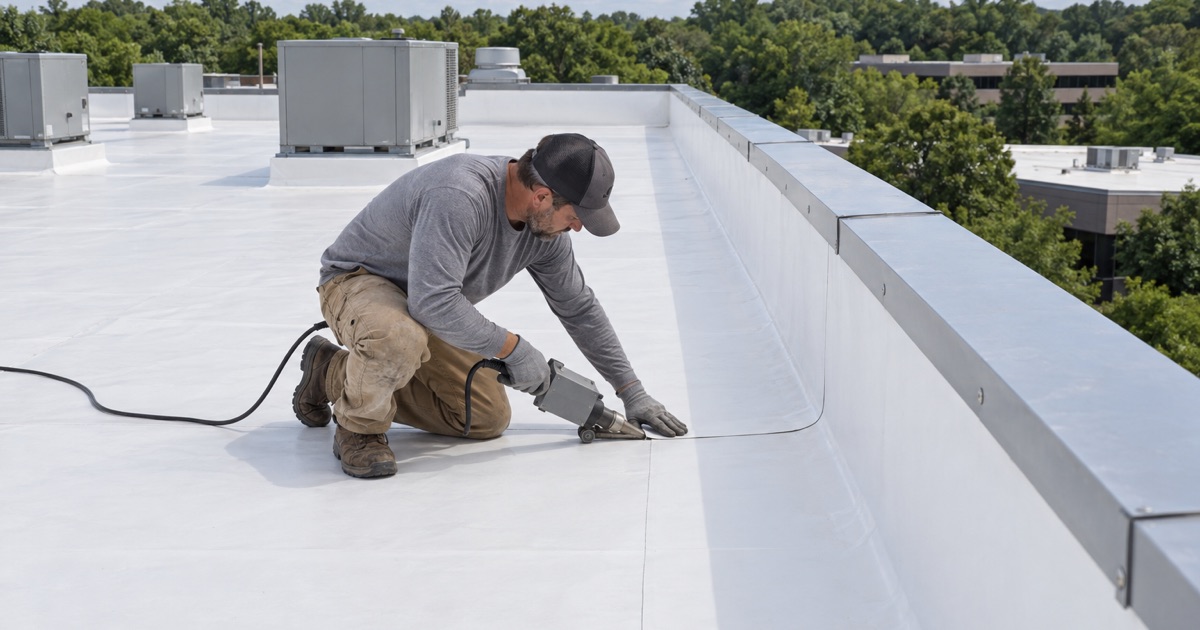
TPO and PVC are single-ply membranes rolled out in wide sheets and heat-welded at the seams. The welded seams become as strong as the membrane itself, and the light-colored surface reflects sunlight to reduce cooling loads. They are common on offices, retail buildings and newer commercial roofs.
PVC holds up particularly well where grease or chemicals may reach the roof, such as near restaurant exhaust. TPO is a cost-effective choice for many general commercial roofs. We explain the differences and recommend the membrane that fits the building’s use.
EPDM Rubber Roofing
EPDM is a synthetic rubber membrane with a long track record on low-slope roofs. It stays flexible in cold weather, resists weathering and is relatively simple to repair. Seams are joined with tape or adhesive rather than heat welding.
EPDM is common on older commercial buildings and on low-slope sections of homes and mixed-use properties. Many roofs we see in the area already have EPDM, and repairing or replacing it with the same material is often the simplest path. We check the seams and flashing closely, since those are where EPDM usually fails.
Modified Bitumen Roofing
Modified bitumen is a multi-layer asphalt-based system, installed by torch, cold adhesive or self-adhering sheets. Both SBS and APP modified bitumen are used on commercial roofs. The multiple layers make it tough and well suited to roofs that see foot traffic.
It is also common on smaller mixed-use buildings with apartments above a storefront. Modified bitumen works well around rooftop equipment and in areas where maintenance crews walk often. We use torch-down methods only where safe, and cold or self-adhering methods where an open flame is not appropriate.
Commercial Roof Repair and Maintenance
Finding and Fixing Leaks
Commercial roof leaks often travel along the deck or insulation before showing up inside, sometimes far from the opening. We start with the interior evidence and the roof plan, then inspect seams, flashing and penetrations in the matching area. Open seams, failed perimeter flashing and punctures around rooftop units are the most common sources.
Each repair uses material compatible with the existing membrane, so it bonds properly. We photograph the problem and the finished repair. Building owners receive a short report of what was found and fixed.
Drains, Scuppers and Ponding Water
Low-slope roofs depend on drains, scuppers and gutters to move water off. When they clog with leaves or debris, water ponds on the roof, adding weight and speeding up wear on the membrane. Ponding that lingers long after a rain is a sign that drainage needs attention.
We clear drains and scuppers, check that strainers are in place, and look for low spots where water collects. Where ponding is persistent, tapered insulation or added drains may be the answer. We explain the options and their costs.
Rooftop Equipment and Penetrations
HVAC units, exhaust fans, vent stacks and conduit all pass through the roof, and each needs flashing that stays sealed. Equipment curbs and pitch pans are common leak points as sealants age and units vibrate. Service technicians walking the roof can also damage the membrane.
We inspect and repair flashing around every penetration. Where foot traffic is heavy, walkway pads protect the membrane between the access point and the equipment. That simple step prevents many punctures.
Planning a Commercial Roof Replacement
Moisture Checks and Recover Options
Before recommending replacement, we check whether the insulation under the membrane is wet. Wet insulation loses its value and holds water against the deck. If the existing roof is dry and only one layer, a recover can save money compared with a full tear-off.
Where the insulation is wet or several layers already exist, a full tear-off is the right choice. We explain the findings and both options in writing. The building owner decides with clear information.
Permits, Safety and Scheduling
Reroofing a commercial or multifamily building generally requires a permit under New Jersey’s Uniform Construction Code. We confirm the requirements with the local construction office before starting. Fall protection and safety measures are in place on every roof we work on.
We plan the work around business hours and tenant access where possible. Deliveries, crane lifts and noisy tear-off are scheduled to limit disruption. The roof is watertight at the end of each day.
Multifamily and Association Roofs
Condominium and townhouse communities often have roofs owned and maintained by the association. We work with boards and property managers to plan repairs and replacements, often phased across several buildings. Our written condition reports help associations prioritize work and plan reserve funding.
In New Jersey, planned real estate developments are expected to maintain capital reserve studies, and roofs are often among the largest items in them. Clear condition reports make those studies more accurate. We provide the information the board and its reserve specialist need.
- 20+ Years on Local Roofs
- Itemized Written Scopes
- Same-Day Storm Tarping